
Dr Födisch
Dr. Födisch is a leading manufacturer of CEMS monitoring air pollutants, dust and flow. Their measuring devices “made in Germany” have been used in operation worldwide for more than 30 years now. The clientele comprises of power plants, cement plants, incinerators for waste, biomass and sewage sludge as well as plants for chemical and metallurgical industry. A wide service and maintenance network and on-call duties guarantees short and quick routes to customers nationwide and abroad.

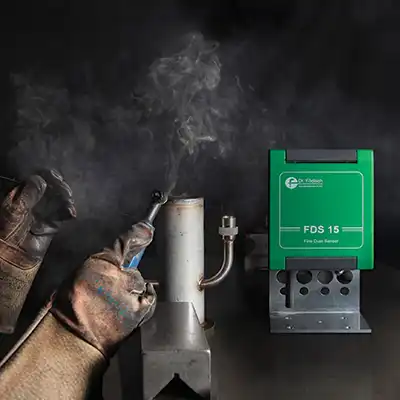
Dust measurement
There is dust everywhere in our environment. Industrial processes are the reason for dust and because of the general population growth dust particles continue to increase. The permanent control of dust emissions is becoming more and more important. Especially considered worldwide the potential and the necessity are high. Country-specific, legal conditions specify the compliance with limit values for certain plants.
For emissions and pollution monitoring, Dr Fodisch provides dust measurement techniques for legally required and process-related measuring tasks.
Products available for:
- Fine dust
- Filter monitoring
- Dust concentration
Fine Dust - tracing particulate matter
The air is the elixir of life. However, the air contains impurities, whose composition and concentration vary depending on the location. Various researches have shown that the fine dust particles in the air are damaging to the heart, lungs and brain. For measurement is often used complex and expensive measurement technology. Thanks to the compact fine dust sensors of Dr. Födisch Umweltmesstechnik AG this is now history. These are a low cost measuring devices for industrial applications.
Whether the application is for outdoor, indoor, stationary or mobile – the device handling is easy, the measurements are precise and independent from the weather conditions. By means of preconditioned air the particulate matter content of the air is measured every two seconds. By WLAN, the the devices can be linked to other air quality / climate sensors to achieve an efficient, meaningful environmental monitoring. There are many benefiting advantages, for example the analysis of ambient air for particulate matters at workplaces.
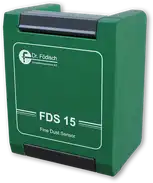
- optical sensor for continuous measurement and monitoring of fine dust concentrations (PM10, PM2.5)
- smart, robust, network-capable
- simple unit design
- installation without any special tools
Filter monitoring
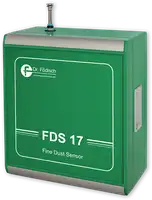
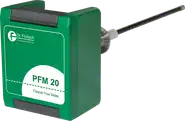
A qualitative dust measurement, for example by triboelectric filter monitoring, includes both the monitoring of the clean gas dust content after dust collectors as well as the evaluation of the status of the exhaust gas cleaning systems.
The signal generation is based on the triboelectric measuring principle. In other words the charge exchange between the probe and the streaming as well as the bouncing dust particles is carried out.
According to the triboelectric measuring principle the filter monitoring device will be installed as in-situ measuring device in the clean gas pipes after the dust collectors. Devices are suitable for monitoring baghouse-, envelope- and cartridge filters and centrifugal separators (cyclones).
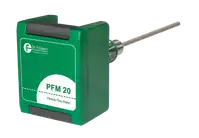
- continuous, tribo-electric in-situ measurement
- qualitative monitoring of filtering dust precipitators
- compact filter monitor with integrated operating element (connection for separate display/operating unit, display/operating unit optional)
- configurable length of probe rod and isolator
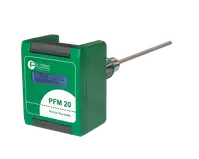 continuous, tribo-electric in-situ measurement
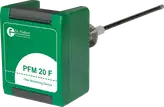 suitability tested EN 15267, QAL1 certified
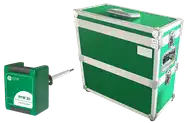 easy and safe handling of complete system thanks to portable case design
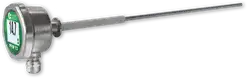 filter monitor for in-situ dust measurement
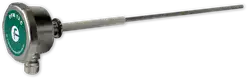 filter monitor for in-situ dust measurement
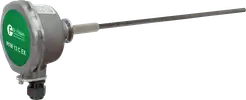 continuous, tribo-electric in-situ filter monitoring device with EC-Type Examination Certificate (IBExU19ATEXB008 X)
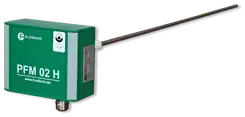 residual dust sensor for wood processing industry with the EC-type examination certificate
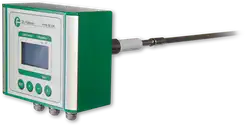 filter monitor for in-situ dust measurement with EC-Type Examination Certificate (IBExU04ATEX1249 X)
Dust concentration
Devices used for the continuous dust measurement register in the wider sense the physical changes caused by the particles in the measuring system converting them into electrical signals. For that the measured object can be analysed directly in exhaust gas channel (in-situ measurement) or a partial volume flow is collected and fed into a measuring device (extractive sampling).
As result of the in-situ techniques, the measurement signals derive from the direct interaction of light or a triboelectric probe with the dust particles in the exhaust gas channel. For evaluation the scattered light or the absorbance of a transmitted light beam respectively triboelectricity can be used.
The in-situ measuring devices are only suitable for the measurement of dust in dry gases.
In case of wet or saturated with water vapour gases, the existing water droplets and aerosols create also light scattering effects, which distort the measurements results. Therefore in these cases the extractive measurement technique should be selected. The basis of the extractive methods constructs a preferably isokinetic partial flow extraction from the main gas flow. As measuring principles the scattered light measurement or the triboelectric measurement can be carried out.
The process-related restrictions have substantial influence over the choice of the measurement method.
Periodic dust concentration measurements are usually used as a standard reference method (gravimetric) for calibration of continuous dust concentration measuring devices.
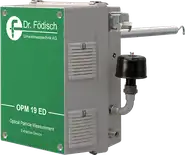
- suitability tested EN 15267; QAL1 and MCERTS certified
- extractive measurement in wet and sticky exhaust gases
- optical scattered light measurement
- measuring gas is sampled by a temperature regulated probe
- measuring range: dust (in operation) 0...7.5 mg/m³ (max. 250 mg/m³)
 suitability tested EN 15267; QAL1 and MCERTS certified
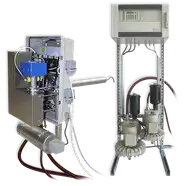 extractive optic dust concentration measurement
Gas analytics
In the area of analysis technology, Dr Födisch offers you measuring devices and systems for versatile applications. Regardless whether it is for hot or cold gas analysis as well as for stationary or mobile measurement - you will find the right measuring instrument. There can be up to twelve measuring components such as CO, NO, SO2, HCl, NH3 and H2O precisely determined. Special applications complete the product range portfolio.
Products available for:
- Emission measurement
- Process measurement
- Hot-wet gas analysis
- Cold-dry gas analysis
- Oxygen measurement
Emission measurement
Industrial plants requiring approval are subject to strict requirements for compliance of emissions limit values. For monitoring it is only allowed to use measuring devices approved by the Federal Environment Agency. The approval requirements are defined in EN 15267. The number of measured components depends on the plant type, but also on the used fuel.
The determination of the gaseous components takes place after the extractive method of measurement. Therefore a partial gas stream is withdrawn from the exhaust gas stack and led via gas sampling probe to the analyser cabinet.
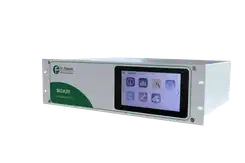
- measurement of up to 8 gas components in flue gas and for process control
- automatic zero point setting by means of ambient air
- Filtercal technology for reference point adjustment; without gas consumption
- QAL1 certification according DIN EN 15267-1 (2009), DIN EN 15267-2 (2009), DIN EN 15267-3 (2008) in progress
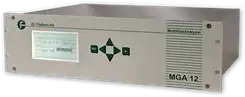 multi gas analyser for extractive gas component measurement
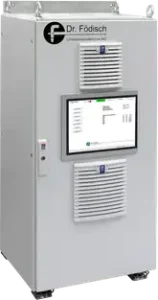 compact and robust measuring system with easy operating
Process measurement
All Dr. Födisch emission measuring devices or systems can in principle also be used for various process applications. Furthermore devices for special requirements and applications are designed by Dr. Födisch technical-team.
Typical applications are:
- Delta CO (carbon monoxide) measurements for monitoring smouldering fire, e. g. in coal mills, coal silos or baghouse filters
- Delta NO (nitric oxide) measurements for denitrification plants control
- NH3 (ammonia) latency measurements at SCR / SNCR systems
- HCl (hydrogen chloride)- and SO2 (sulphur dioxide) measurements in the raw gas for the flue gas cleaning systems / desulphurisation plants control
- O2 (oxygen) measurement for monitoring inerting systems in chemical and pharmaceutical industries
Extractive solutions are in particular suitable and used. Thereby sensitive measurement technology is not directly exposed to the often harsh exhaust conditions. By modifying the sample extraction even the most difficult applications (high temperatures, very high dust content, corrosion) can be solved.
- measurement of up to 8 gas components in flue gas and for process control
- automatic zero point setting by means of ambient air
- Filtercal technology for reference point adjustment; without gas consumption
- QAL1 certification according DIN EN 15267-1 (2009), DIN EN 15267-2 (2009), DIN EN 15267-3 (2008) in progress
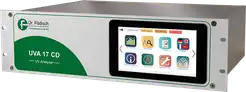 analyser module in 19" housing
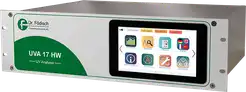 analyser module in 19" housing
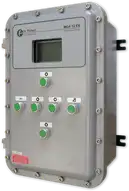 simultaneous measurement of up to 5 gas components
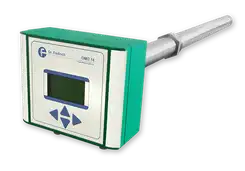 measuring the concentration of the free oxygen in flue gas and process gases
Hot-wet gas analysis
The method of hot-wet gas analysis is widely used – in power plants, in waste incinerations, in paper, glass and cement industries and many more. A partial flow of gaseous components is withdrawn by a sampling probe and sampling pipe and led to the analyser cabinet. The sample gas is tempered at 185 °C for the whole gas path and monitored for flow and temperature. This high temperature level is necessary in order to prevent condensing of water-soluble components.
The multi-component analyser is the heart of the hot-wet measuring system analysing simultaneously up to 12 components. That includes e.g. HCl, NH3, H2O, CO, NO, NO2, CH4, SO2 and CO2. Oxygen is measured by an integrated zirconium dioxide sensor.
Dr Födisch gas analysers are qualified for almost all applications. The types MCA 04 and MCA 10 passed the suitability test and got certification according to EN 15267-3 (QAL1). Mobile measuring equipment offers high flexibility for special situations.
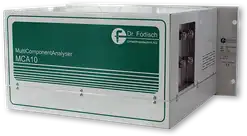
- extractive multicomponent analysis system
- hot-wet gas analysis
- QAL 1 & MCERTS according to EN 15267-3
- approved for installations according to IED
- max. 11 infrared components as well as oxygen
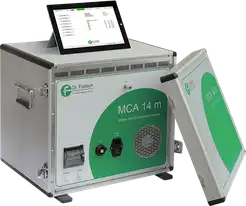 mobile hot-wet gas analysis system
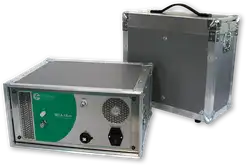 mobile hot gas analyser system as lightweight 2-case design
Cold-dry gas analysis
Cold-dry measurement is – same like hot-wet measurement – based on the extractive working principle. A partial flow of gaseous components is withdrawn by a sampling probe and sampling pipe and led to the analysis cabinet. A gas conditioning inside the cabinet cools the sample gas to 5 °C. Then up to five components are measured in parallel – a real added value for you.
For the detection of smells i.e. metal oxide sensors are applied.
- measurement of up to 8 gas components in flue gas and for process control
- automatic zero point setting by means of ambient air
- Filtercal technology for reference point adjustment; without gas consumption
- QAL1 certification according DIN EN 15267-1 (2009), DIN EN 15267-2 (2009), DIN EN 15267-3 (2008) in progress
Oxygen measurement
Quick and exact oxygen measuring values by direct in-situ measurements are necessary for optimization of combustion control and emission monitoring. The Dr. Födisch oxygen analyser is used for oxygen concentration measurement in flue and process gases.
The oxygen is measured by a zirconium dioxide cell, whereby the concentration of free oxygen is analysed. Based on the proven proportionality of signal and concentration a constant accuracy in all oxygen concentration ranges is ensured.
 extractive cold-dry measurement
- based on electro-chemical cell or paramagnetic sensor alternatively
- optionally further measuring components possible
- easy operation and maintenance
Flow measurement
The continuous velocity and temperature measurement is very important when operating a system with gas flows (for example indoor exhaust air, exhaust gases).
At emission measurements the current concentrations are determined. For conversion into absolute emitted masses one needs the volume, which is calculated on the gas velocity. This also plays an important role in emissions allowance trading.
- continuous measurement of exhaust gas velocity, exhaust gas flow, pressure and temperature
- compact unit with differential pressure probe
- can be used in flue gases with high dust contents
- suitability tested and certified according to EN 15267-3 (QAL1)
- approved for all plants covered by IED
 continuous measurement of exhaust gas velocity, exhaust gas flow, pressure and temperature
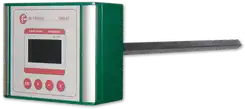 continuous flow measuring device for the measurement of exhaust gas velocity respectively flow and temperature